Specifications, and the conditions they were measured under
Typical values per family. Final parameters are confirmed on the quotation against your duty cycle — if a figure here does not match your tender, send the tender and we quote to that.
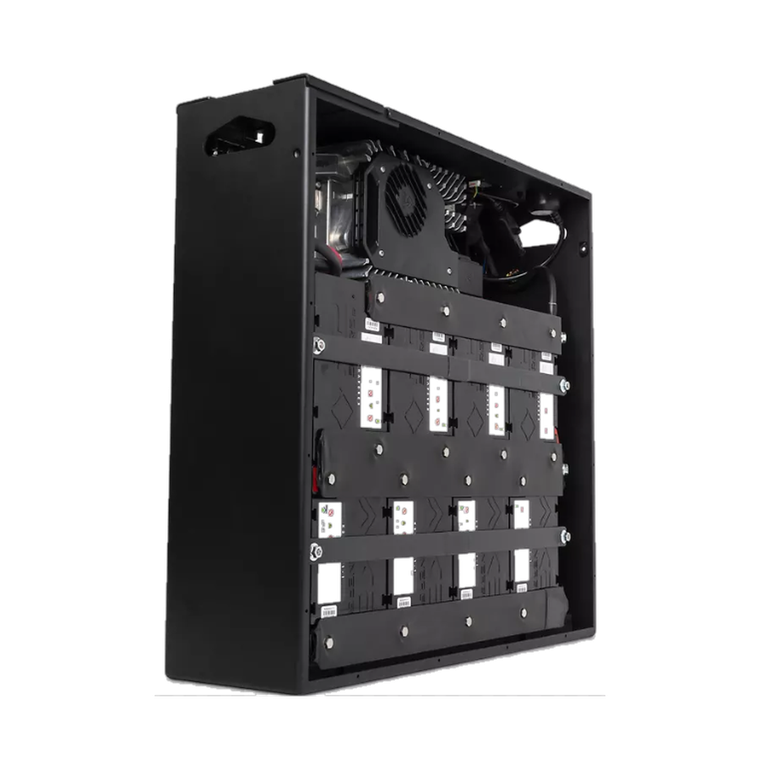
Residential Storage
Wall-mounted and stackable LFP for solar self-consumption and whole-home backup, matched to the hybrid inverter already specified for the project.
- Usable capacity5.1 – 30.7 kWh
- Nominal voltage51.2 V
- ChemistryLiFePO₄
C&I Cabinet
Outdoor all-in-one cabinets for peak shaving and demand-charge management. Battery, PCS, EMS, thermal management and fire suppression integrated and tested as one unit.
- Capacity100 – 500 kWh
- CoolingLiquid or forced air
- EnclosureIP54 / IP55
Containerised BESS
Utility-scale 20-foot systems for renewable firming, frequency response and capacity markets. Liquid-cooled, 1500 V DC, with the full compliance and commissioning pack.
- Capacity per unit3.44 – 5.0 MWh
- DC architecture1500 V
- CoolingLiquid
LFP Cells & Modules
Grade-A prismatic cells and pre-assembled modules for pack builders, supplied with matched capacity and internal resistance so the pack balances the way the BMS expects.
- Cell capacity280 / 314 / 320 Ah
- Nominal voltage3.2 V
- GradingGrade A, matched
Telecom & Data Centre Racks
Rack batteries for telecom sites, UPS replacement and data-centre backup. Drop-in footprint for VRLA strings with parallel operation and real state-of-charge telemetry.
- Nominal voltage48 V / 51.2 V
- Capacity50 – 200 Ah
- Form factor19" rack, 2U – 4U
Full specifications
Every figure below is a typical value for that family, confirmed per order.
Residential Storage
5 – 30 kWh · 51.2 V
| Minimum order | 1 unit |
| Price range | US$10,000 – 30,000 |
| Module capacity | 5.12 kWh (51.2 V / 100 Ah), stackable |
| Depth of discharge | 90 % usable |
| Cycle life | ≥ 6 000 at 0.5C, 80 % DoD, 25 °C |
| Round-trip efficiency | ≥ 95 % DC side |
| Operating temperature | Charge 0–55 °C · Discharge −20–55 °C |
| Enclosure | IP21 indoor, wall or floor stack |
| Inverter compatibility | Protocol matched per project before shipment |
| Standards | UL 1973, IEC 62619, IEC 63056, UN 38.3 |
C&I Cabinet
100 – 500 kWh cabinet
| Minimum order | 1 unit |
| Price range | US$40,000 – 150,000 |
| Typical configurations | 100 / 215 / 261 / 372 kWh |
| Power rating | 50 – 250 kW, 0.5C standard |
| Cooling | Liquid cooling standard above 200 kWh |
| Fire suppression | Aerosol or clean agent, pack-level detection |
| Enclosure rating | IP54 / IP55, −30 – 55 °C ambient |
| Monitoring | EMS with Modbus TCP / SCADA |
| Grid interface | Per local grid code, confirmed at design stage |
| Standards | UL 9540, UL 9540A, UL 1973, NFPA 855, IEC 62933 |
Containerised BESS
20 ft · 3.4 – 5 MWh
| Minimum order | 1 unit |
| Price range | US$500,000 – 1,000,000 |
| Energy per container | 3.44 / 3.72 / 5.0 MWh by generation |
| C-rate | 0.25C – 1C by application |
| Cooling | Liquid, cell temperature spread ≤ 3 °C |
| Fire protection | Detection, suppression and exhaust to NFPA 855 |
| Auxiliary | Integrated HVAC, lighting, access control |
| Augmentation | Capacity top-up planned against the degradation curve |
| Documentation | FAT report, UL 9540A data, commissioning plan |
| Standards | UL 9540, UL 9540A, IEC 62933, NFPA 855, UN 38.3 |
LFP Cells & Modules
280 / 314 / 320 Ah
| Minimum order | 1 unit |
| Price range | US$30,000 – 90,000 |
| Nominal voltage | 3.2 V, operating 2.5 – 3.65 V |
| Capacity grades | 280 / 314 / 320 Ah prismatic |
| Matching tolerance | Capacity and internal resistance matched per batch |
| Cycle life | ≥ 6 000 at 0.5C 80 % DoD; ≥ 8 000 current generations |
| Operating temperature | Charge 0–55 °C · Discharge −20–55 °C |
| Test data | Capacity, IR, OCV and self-discharge per cell |
| Transport | UN 38.3 report, class 9 dangerous goods |
| Standards | IEC 62619, UL 1973, GB/T 36276, UN 38.3 |
Telecom & Data Centre Racks
48 V · 19-inch rack
| Minimum order | 1 unit |
| Price range | US$30,000 – 60,000 |
| Module | 48 V 100 Ah (5.12 kWh), 3U standard |
| Parallel operation | Up to 16 units, automatic addressing |
| Design life | ≥ 10 years at 25 °C float |
| Cycle life | ≥ 6 000 at 0.5C, 80 % DoD |
| Monitoring | RS485 / CAN / SNMP, dry-contact alarms |
| Replacement | Matches common VRLA rack footprints |
| Standards | UL 1973, IEC 62619, UN 38.3 |
BMS, PCS & EMS Integration
BMS · PCS · EMS
| Minimum order | 1 unit |
| Price range | US$30,000 – 200,000 |
| BMS architecture | Three-level: cell, module, rack controller |
| Protection | Over/under voltage, over-current, over-temperature, isolation |
| Balancing | Passive standard, active on request |
| PCS | Grid-tied, off-grid or hybrid per grid code |
| EMS functions | Peak shaving, time-of-use, demand response, backup priority |
| Integration | Modbus TCP/RTU, CAN 2.0B, SNMP, REST where supported |
| Grid compliance | UL 1741 SA/SB, IEEE 1547 or local equivalent |
| Standards | UL 1741, IEEE 1547, IEC 62933, IEC 61000 |
What the systems are built to
These are the published standards the configurations above are built and tested against. They are public documents — if your tender or local authority references a different one, send it and we respond against that instead.
Certificates are held by the manufacturer of the cell, module or system and are supplied in that holder's name. We say which certificate belongs to whom rather than implying it is ours.
| Standard | Scope |
|---|---|
| UL 1973 | Batteries for stationary and motive auxiliary power |
| UL 9540 | Energy storage systems and equipment |
| UL 9540A | Thermal runaway fire propagation test method |
| UL 1741 SA / SB | Inverters and converters, grid-support functions |
| IEEE 1547 | Interconnection of distributed energy resources |
| IEC 62619 | Safety for secondary lithium cells, industrial use |
| IEC 63056 | Safety for lithium batteries in energy storage |
| IEC 62933 | Electrical energy storage systems |
| NFPA 855 | Installation of stationary energy storage systems |
| UN 38.3 | Lithium battery transport test criteria |
| EU 2023/1542 | EU Battery Regulation |
| IEC 61000 | Electromagnetic compatibility |
Questions worth asking before you order
If a supplier cannot answer these clearly, that is itself an answer.
What do you need from me to quote?
Energy in kWh and power in kW, the application, nominal voltage and whether it is AC- or DC-coupled, the duty cycle, ambient conditions, indoor or outdoor, the grid code that applies, and the delivery location. For a peak-shaving case, interval meter data changes the sizing more than anything else on the list.
Why LFP rather than NMC?
Thermal stability and cycle life. LFP has a higher thermal runaway onset temperature and degrades more slowly under daily cycling, which is what stationary duty is. NMC wins on energy density, which matters in a vehicle and rarely in a cabinet.
What cycle life should I expect?
Published figures assume conditions — usually 0.5C, 80 % DoD and 25 °C. Faster rates, deeper discharge and higher ambient all reduce it. We quote the figure with its test conditions attached, because a cycle number alone is not a specification.
Air cooling or liquid cooling?
Below roughly 200 kWh forced air is usually adequate and simpler to maintain. Above that, liquid cooling keeps cell-to-cell temperature spread within a few degrees, which directly slows degradation and is effectively standard for containers.
Do I need UL 9540A test data?
In most US jurisdictions, yes. The authority having jurisdiction generally requires 9540A results to approve the installation under NFPA 855, particularly indoors or at close spacing. Confirm it before ordering, not after.
Can you match my existing inverter?
Usually, but it has to be confirmed rather than assumed. Compatibility means the BMS and inverter agree on a protocol and the pairing is on the inverter maker's approved list. Send the make and model with the enquiry.
How is shipping handled?
Lithium is class 9 dangerous goods. Every shipment needs a valid UN 38.3 report, compliant packing and a dangerous goods declaration. Sea freight is normal for containers and cabinets; air freight is possible for small modules but expensive and restricted.
How do I spot downgraded cells?
By the data, not the label. Ask for capacity, internal resistance, OCV and self-discharge records traceable to cell serial numbers, and the maker's grading definition in writing. Cells well below market price are usually B-grade or recovered stock, and they will not balance.
What should a warranty cover?
Three things often confused: a term in years, a throughput limit in cycles or MWh, and a capacity retention figure at end of term. A warranty quoting only years tells you very little. We state all three, plus who performs service and where.
Payment and delivery terms?
Quoted per order against incoterms and destination. Lead time, terms and the applicable incoterm are stated in writing on the quotation before anything is confirmed.